latest News

Xero Shoes Sponsors USA Artistic Swimming
FOR IMMEDIATE RELEASEEmily Falkenberg | USAAS | emily@usaartisticswim.orgLaura Beachy | Xero Shoes | beachy@beachymedia.comUSA Artistic Swimming Announces Partnership with Xero ShoesCOLORADO SPRINGS, CO – (July 8, 2020) - USA Artistic Swimming signs Xero Shoes as its official footwear partner providing athletes innovative shoes that match the team’s style in the water. “They are not your conventional shoe, and we are not your conventional sport,” said USA Artistic Swimming CEO, Adam Andrasko. “We both embrace what is special about ourselves and use it in a positive way.”Established 41 years ago, USA Artistic Swimming officially rebranded from USA Synchronized Swimming in March. Artistic swimming is a women's Olympic discipline which combines technical perfection, synchronisation, choreography, artistry and expressive power. Athletes wear beautifully decorated swimsuits and waterproof make-up. They often perform choreography and use music that is unique to their heritage, creating a rich and distinctive spectacle.Xero Shoes’ lightweight footwear prides itself on minimalism and natural movement. Xero Shoes have sold hundreds of thousands of shoes, boots, and sandals to customers in 97 countries, ages 2-92, and will now be worn by the USA Artistic Swimming Senior National Team at every international competition. "We're so excited that USAAS asked us to support their incredible athletes and coaches,” said Steven Sashen, Xero Shoes CEO. “We are looking forward to having lots of fun together and helping the team reach their goals, feet first." About USA Artistic SwimmingUSA Artistic Swimming [USAAS] was established as a nonprofit organization in 1979 and is the United States national governing body for the sport. It is recognized by the International Olympic Committee, the United States Olympic Committee and FINA (Federation International de Natation Amateur) — the international governing federation. USAAS organizes, participates in, and promotes a variety of competitive events each year. These events begin at the local level and continue in the following categories: Age Group (12-19), Junior (15-18), Senior and Masters (20+). https://www.teamusa.org/USA-Artistic-SwimmingAbout Xero ShoesFeel The World, Inc. (dba Xero Shoes) of Broomfield, CO, manufactures Xero Shoes®, addictively comfortable, lightweight, performance and casual sandals and shoes built with a “foot-first” design. Durable, stylish and affordable — Xero Shoes supply the fun and benefits of natural, barefoot-inspired movement with a layer of protection and comfort. FTWI launched in December 2009 and now has customers ages 2 to 92, in 97 countries who wear Xero Shoes for walking, hiking, yoga and gym-going, CrossFit, kayaking, rafting, paddle boarding, jogging, and even running hundred-mile ultra marathons. www.xeroshoes.mom

How to find TRULY comfortable shoes
The secret to finding comfortable shoes...It's probably not what you think.And it's definitely not what "Big Shoe" companies have been saying for the last 50 years.It's not because you need more arch support or better cushioning or to control your pronation or supination.The secret is actually what humans have been doing for ages.The secret to TRUE comfort is letting your feet do what's NATURAL.Think about this -- did you know 1/4 of the bones and joints of your ENTIRE body are in your feet and ankles?Did you know you have more nerve endings in your soles than anywhere but your fingertips or lips?CLEARLY, you're supposed to USE those things at the end of your legs.Your feet are made to bend and flex and move and FEEL the world (you'll want to do that safely, and I'll show you how).And it gets worse >> When your feet can't do their job, that function of helping you move and balance tries - UNSUCCESSFULLY -- to move "upstream" into your ankle, your knee, your hip, and your back.You want to let your feet do their job, so the rest of your body can do its job.But most shoes do the opposite of what's natural -- they squeeze your toes together, they elevate your heel (which messes with your posture), they insulate you from the ground so your brain can't tell what's going on with your feet (which means it doesn't have the info it needs to help you move your body efficiently and enjoyably).And NO amount of cushioning protects you from the impact of walking or running, or even just standing.ANOTHER QUESTION -- Remember being a kid on a warm summer day and going outside, kicking off your shoes, and feeling the grass between your toes, or the sand under your feet, or the water around your ankles?Remember how much fun it was to PLAY... until it got so dark your parents had to drag you home, even though you couldn't see your hand in front of your face or the ball you were trying to kick or hit?You can have that feeling of fun and freedom NOW... at any age.It comes from letting your feet do what's natural.Now, I'm NOT suggesting you run around barefoot like some aging hippy (I know that's what I look like, but my wife said she'd leave me if I cut my hair!)Once my wife and I discovered the fun and the benefits of natural movement, we started Xero Shoes to make footwear that LETS YOUR FEET BE FEET: - Natural Fit -- wide toe boxes let your toes spread and relax. A non-elevated (zero-drop) heel for proper posture. - Natural Motion -- super flexible to let your feet bend and move naturally. Low-to-the-ground for balance and agility. - Natural Feel -- the patented FeelTrue® soles give you just-right protection while still giving the ground feedback your brain needs for efficient, natural movement. All our casual and performance shoes, boots and sandals are super lightweight. They're made for almost any activity you do -- walk, run, hike, workout, do yoga or CrossFit, or even just stand on your feet all day for work.They're so comfortable that at the end of the day you may forget to take them off!We've had people email us to say, "I got into bed and then realized I was still wearing my Xero Shoes!"Plus they're affordable and so durable that they have a 5,000 mile sole warranty.Oh, and yes, we WERE on Shark Tank ;-)We've helped hundreds of thousands of people discover the fun, comfort, and benefits of natural movement and we hope you decide to do the same.Go to https://xeroshoes.mom/shop/ to see which styles have your name on them. Check out the reviews (over 17,353 5-star reviews!), and get ready to Live Life Feet First!(And if you have any questions, our Customer Happiness Team is available to help -- 303.447.3100 or support@xeroshoes.mom)
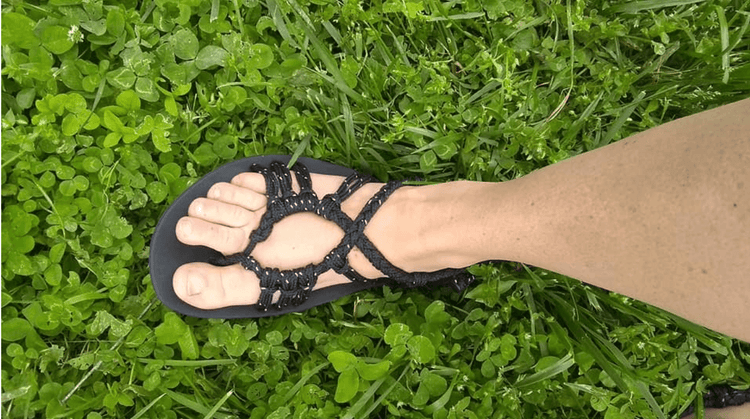
Kelly C's Super Cool DIY Sandal Tying Style
We believe anyone can have the superpower of making their own shoes. Our DIY Kit allows you to cut your footbed and lace away as you wish. However, some of our customers, like Kelly Culp, take it a step further and create extraordinary lace styles like this one, to share with the Xero Shoes world. With these instructions and 10 simple steps, now you can create this stylish masterpiece too, that is simple and takes no time at all but will you make people stop and ask, where did you get those sandals!?*Note: This design takes 3 sets of laces, so get wild with your own personal color scheme!Step One: Punch your holes Once you get your kit in the mail, step on the outsole and mark where your toe hole needs to be for YOU. Then do a double hole punch to pull 2 sets of your laces through.Place three hole punches on either side of your foot as seen in this image. Kelly added an additional hole punch just in front of the arch (seen on the left side of the outsole.) Step Two: Braid your laces (above)Step Three: Create adjustable loopsTake your third set of laces and pull in adjustable loops, the 3 hole punches on the inside of the outsole. Step Four: Fold Laces overFold your laces as seen below so that you can pull the braided laces through in the next step.Step Five: Pull Braided laces through loopsThe loops on the bottom will allow you to adjust the fit when finished. Step Six: Repeat steps 3-5 on the other side of your outsoleStep Seven: Arch Loops and Size AdjustmentsRepeat the process once more, creating loops on both sides of the arch of the foot and pull the braid through. Make final adjustments to your loops so that your feet can slip in comfortably. This is what your sandal should now look like from the top. Feeling those superpowers yet? Good, let’s finish these beauties up. Step Eight: Trim bottom of the laces to about 1/4 of an inch (left). Step Nine: Melt the ends with a lighter/candle and flatten with the backside of the pliers.Step Ten: This is it! Your last step! Just use a square knot technique to create a slide closure (below, Left). Your final knot should look like the below, right image.If your knot looks like this, cheers, you’ve just successfully tied off a square knot and completed Kelly C.'s tying design.Tag us on Instagram if you try this lacing style. And if you come up with cool, new tying ideas, be sure to put them on our Tying Page

COVID-19 Shipping
Due to COVID-19, many countries have suspended postal deliveries, and many others are experiencing extremely long delivery times, something we, unfortunately, learned AFTER shipping many parcels during our recent sale.The below list includes countries we are currently unable to ship to due to COVID-19.Please note this list includes Israel. In addition, there may be significant delays with shipments to any international location, including Japan and Europe.If you're in one of these countries please check xeroshoes.mom/stores to see if there's a retailer or distributor nearer to you that's open and/or able to ship to you. New Restricted Countries Bermuda Brunei Cape Verde French Guiana Israel Italy Saudi Arabia St. Martin UAE Western Sahara Updated March 27th, 2024

Do Running Shoes CAUSE Injuries?
When I talk to many runners who still use "traditional" running shoes,and then tell them about Xero Shoes, they often say "Well, there's a debate about barefoot/minimalist shoes."First, the quotes are because what we call "traditional" running shoes have only been around for less than 0.05% of the time humans have been wearing protective footwear.Second, there's really no debate.There are people who have opinions that barefoot/minimal is somehow bad based on limited amounts of research, or anecdotes, or information put out by companies that make traditional shoes, and then there is...THE TRUTHYes, I'm implying that the truth is: Natural Movement -- whether you're barefoot or in a truly minimalist shoe like Xero Shoes -- is demonstrably better than being in a padded, motion-controlled, heel-elevated, toe-squeezing shoe.But rather than hash out all my reasons for saying this (which I've done many times on this site), here's a great article that examines "shoes vs. barefoot":https://theconversation.com/running-shoes-may-cause-injuries-but-is-going-barefoot-the-fix-135264Here's the highlight:...if you want to give barefoot running a try, the best advice is to walk before you run. A minimalist shoe might be a good first step if walking or running in extreme temperatures or where sharp objects may be common. Although minimalist shoes aren’t the same as being barefoot, the mechanics runners and walkers use in them are very similar to when barefoot – and dramatically different to when in shoes.And this is the key point. It's about the MOVEMENT, not about the footwear. It just so happens that natural movement is fundamentally impossible in a shoe that, well, doesn't let your foot move. And a truly minimalist shoe can let your body do what's natural, and let your feet bend, flex, move, and FEEL.BTW, a "truly minimalist" shoe isn't the same as a shoe that's marketed as "minimalist" but that doesn't let your toes splay, your foot fend and flex, and your sole get feedback from the ground (which it sends to your brain to help your movement, balance, and agility).
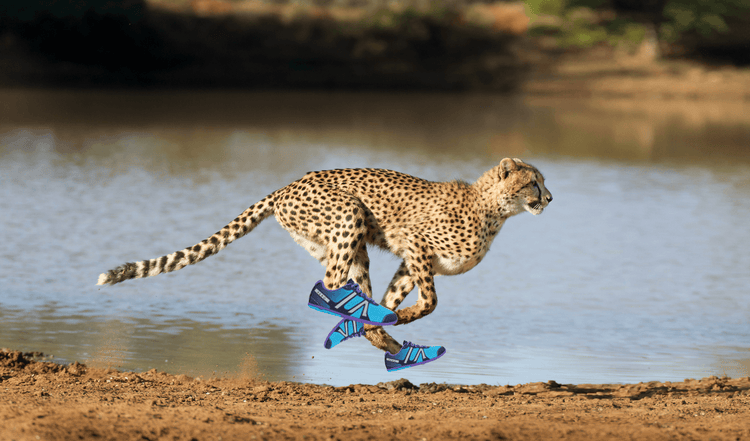
Spot Xero Shoes During Your Next Safari!
Introducing the Front Runner, the first shoe designed to improve the health and performance of rehabilitating cheetahs.The design idea came from New York City Zoologist, Dr. Lex Rodriguez, after noticing that when cheetahs were released back into the wild, the paws of these magnificent cats were not able to handle sticker burrs, hot gravel, sharp rocks, and even the friction they develop by running at over 60 miles per hour.Says Dr. Rodriguez, "I've worn Xero Shoes for years and it occurred to me that the protection, and ground feel you get from these shoes, could be effective for helping these animals transition back to their natural habitat.When he was approached for this project, Xero Shoes CEO was instantly interested."I've been a competitive sprinter since I was a kid," says Sashen. "So it's not surprising that cheetahs are my favorite animal."The Xero Shoes team took their top-selling running shoe, the HFS, and quickly adapted it for feline feet.Both Xero and Dr. Rodriguez were initially skeptical about how the animals would adapt to wearing footwear."We've all seen how domestic cats behave when they step on tape," Sashen said. "They walk around trying to shake it off. We thought the big cats might react the same way."Dr. Rodriquez was more than pleasantly surprised by the initial results. “It’s amazing. They adapted almost instantly. It’s like they don’t even notice or feel anything different, but their performance tells a different story.”Over the last 7 months, the Front Runner was tested on 3 cheetahs of different ages that were preparing for reintegration back into the wild.Reports Dr. Rodriguez, "Wearing the shoes prevented their pads from becoming raw, so they were able to run longer, but they still have the same excellent balance and agility, and their toes can still flex and bend naturally."Most surprising, the cheetahs increased their top speeds by 6%.The zoological research team is still investigating how the performance improvement happens, but the current theory is that the dual-chevron tread gives great traction, without the energy loss that occurs when claws have to dig into the ground.Xero made one significant change between the running shoes they sell online—the Prio, Speed Force, and HFS—they added "Prey Slots" in the FeelTrue rubber soles to allow the cheetah's claws to work naturally when the animal catches prey."There's no value being faster," says Dr. Rodriguez, "if, once you catch up to your prey, you can't, well, finish the job."With just the right amount of protection, the Front Runner should enhance the cheetah's ability to effectively hunt no matter what the elements, keeping the population of prey animals in check and ultimately—helping plant-life by preventing overgrazing.Based on these results, Xero has been approached to develop performance-enhancing footwear for other animals, speedsters and otherwise, including those raised in the wild.Says Sashen, furtively, "I'm not supposed to talk about our 'skunkworks' projects, but we're working on shoes for ostriches, orangutans, and ferrets." Preliminary results are expected by this same date next year.
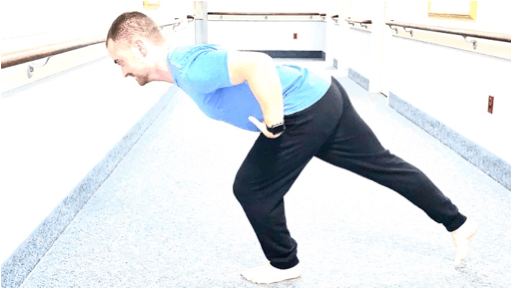
How to Perfect Your Balance
Have you always thought that you just aren't someone with good balance and that's that? Think again. It is totally possible to improve your balance! So how do you do it? Just like a weightlifter needs to lift progressively heavier weights to get stronger, if you want to improve your balance, you need to challenge your balance by placing yourself in unstable positions. In doing so, your body will develop the reflexes needed to maintain balance in that unstable state. This means that you need to be doing exercises that make you wobble...for if you are not wobbling, you are not being challenged. In time, a given activity that once made you wobble, will soon become easy and so you will need to move on to a more difficult activity.Safety first: If you’re concerned that you might fall during a balance exercise, always keep your hand close to some type of support like a sink, counter, or sturdy chair. However, when performing the exercises, you should keep your hands just above your security support and only use them when you feel like you may fall. By having your hands just above the support, you will not rely on your hands to steady yourself and instead will use the balance reflexes found in your feet, legs, and torso. So, let's begin. For an extensive list of balance exercises I regularly use as a physical therapist for patients, head to https://programs.perfectingmovement.net/catalogIf those exercises are either too easy or too difficult for you, all balance exercises can be made more difficult by reducing the amount of visual input you are receiving. This can be done by performing the activity in a darkened room, with eyes squinted, or with eyes closed. In this way, it will limit the amount of visual input your brain receives and so will force you to rely more on your other systems for sensory input.Exercises can also be progressed/modified by standing on an unstable surface such as a foam pad, BOSU ball, wobble board or even a slack line, all of which of course will make you wobble more. As always, anytime you are wobbling, you are challenging yourself and are actively in the process of making your balance better!In this program, I have balance exercises for people of all ages ranging from high-level athletes to geriatrics.So, are balance exercises for athletes too??Absah-freakin-lutely...having good balance as an athlete is crucial toward preventing injuries. This is because good balance is essentially having good neuromuscular control. Without good neuromuscular control, one loses control during movement, and so is at a much higher risk of getting injured. Think about it: Running, cutting, sprinting, braking: all of this happens on one leg at a time. Therefore it is essential to have good neuromuscular control on one leg; ie good balance. Squats and deadlifts are great exercises, but they won’t improve your control/balance on one leg needed for activities like sprinting, cutting, running, and pivoting. Therefore, awesome single balance = not getting hurt = being a real winner.Footwear which can immediately create better balance:When using a thinner, flatter shoe with a wide toe box, one typically has better balance. This type of footwear is called “minimalist”, or “barefoot” footwear. Xero Shoes are definitely my preferred minimalist shoe brand.Here are some of the characteristics and benefits of a minimalist footwear: A wide toe box which allows the toes to splay, creating a wider base of support. A flat sole without support which does not throw off the natural positioning of the foot and ankle. A thin sole which places one’s center of gravity lower to the ground to create improved stability. A thin sole which also allows one to feel the ground more easily. In this way the brain has faster and more descript sensory input needed to create more rapid and effective balance reflexes. In contrast, most traditional shoes have thicker soles, motion limiting “support”, narrow toe boxes, and elevated heels. All of this will disrupt the body’s natural sensory and reactive needed to maintain balance.As a physical therapist, I have had AMAZING success in getting my patients in a minimalist footwear for both reducing pain and improving balance. Once my patients start using minimalist footwear, it is extremely common that they report feeling more balanced and more confident on their feet.Lastly, it is essential that one learns how to walk with proper technique in order to prevent a loss of balance, slip, or a rolling of the ankle. This is because walking with good technique places the foot more beneath the center of mass so that you have better control. Often people take an excessively long stride where the foot is too far forward from the center of mass. The further the foot is away, the less control you have and so are at higher risk of injury. As a guy who used to constantly sprain his ankle, I no longer do so. What changed? I almost exclusively use minimalist shoes and have improved my walking and running techniques. Here is a great video resource to learn how to walk the right way from PerfectingMovement.Net.– James O’Brien MSPT, OCS, CSCS, from PerfectingMovement.netThe content of this post does not constitute and is not intended to be a substitute for professional medical advice, diagnosis or treatment. Always seek the advice of a physician or other qualified health provider with any questions or concerns you may have about your health or a medical condition.

Foot Care for Endurance Athletes
“And forget not that the earth delights to feel your bare feet.” Khalil GibranOf the 206 bones in your body, 52 are in your feet. Each and every one contributes to getting you to where you are going and is a potential major hindrance if not cared for. As a long distance, long term athlete, I spend a lot of time on my feet. Over the last 7 years I have hiked 12,000 miles, paddled 1,500 miles, and bikepacked 4,000 miles. With 3,500 miles left to complete a non-motorized traverse of the Americas, physical maintenance, and specifically foot care, is crucial.One of the important lessons I’ve learned has been moderation. It sounds silly putting those two thoughts into the same sentence but it is a fundamental truth to how I’ve been able to keep going for so long. Maintaining a pace and stride which works for me, resting when my body needs it, and giving it the resources it needs to stay healthy and moving are all examples of moderation and care which I began learning when I started thru-hiking over a decade ago. And which I continue to learn and relearn when my body makes her demands known or insists in the form of months of illness, repeated bouts of overuse injuries, or other physical break down.Interestingly, these sorts of issues don’t usually spring upon you all at once. There are signs, symptoms. That tweak in your lower back. Is that a one time thing or is that the beginnings of chronic pain? Every endurance athlete knows this fear and the fact is, you never can know which it is going to be. What you can do is incorporate a steady practice of care and strength building to give your body its best chance. Similarly, there are dozens of small things you can do to prevent going down that road, or to aid in recovery as you regain strength and stamina. These are a few of those small practices which can make a big differenceDry Your FeetI spent the first 3 years of my backpacking career battling with trench foot. I came to think it was simply part of the experience. I tried doubling up on socks, traded my way up into Gortex boots and the issue only worsened. When wearing shoes and socks, your feet are experiencing a very different climate than the rest of your body. Usually it is a warm, damp environment, just the sort of place fungus like to grow. I was super glueing deep cracks in my heel shut. Until finally one day I swung in the opposite direction and wore lighter shoes and began airing my feet out more often. I quit sleeping in socks and the issue subsided.If you go barefoot or wear open sandals, your feet will be able to dry naturally. Still, if you are on a multi-day trip, rinse or wipe your feet off at the end of the day, paying special attention to the areas between your toes. Not only will this keep your quilt or sleeping bag cleaner, but it will also keep your foot skin healthier.When you are in a closed shoes sort of environment giving your feet time to air out whenever possible. Whether that is under your desk at work, on a lunch break along the trail, or the drive home from the trailhead, keeping your feet clean and exposed to the open air contributes significantly to your foot health. Mix it UpCross-training caught on in the endurance sport world over the past 20 years. All our muscle groups were made to work together so having one set particularly overdeveloped while others languish, doesn’t serve the sustained health of our physical systems in the long run. The same goes for our feet.While thru-hiking the CDT this past summer, I was retraining my feet after several months spent exclusively in my Xero sandals on sandy beaches and in a kayak. Due to constant high mile days, the weight on my back, and the terrain, I opted to hike in trail runners with more padding and zero drop and quickly began to have arch pain. Thus I began alternating between my sandals and trail runners throughout the day.Once the frosty mornings were past and when I took a breakfast break and aired out my feet, I would switch into my sandals for a few hours until lunch. At big river crossings, on smooth trail, and around camp, I was in my sandals. On thorny bushwhacks, across lava rock, and other rough environments, or at the end of the day when I was tired and not able to be as careful with my step, I would switch back into my trail runners. This switching back and forth made me very aware of my gait which is helpful because a hyper-extended gait is a leading cause of shin splints. While the cushion of the trail runners invited this sort of step, my Xeros reminded me not to fall into that.Thus, if like me, you aren’t ready to spend 100% of your time barefoot, there are still many ways and a lot of space for barefoot practices to improve your awareness of how you move, and your experience of both your body and the outdoors. Thank Your FeetNow, here I may get a bit hoakey for some folks, and I don’t mind if you skip on to the end, but at the end of a long and challenging day, I like to thank my feet. I leave my shoes at the vestibule, peel off my socks, and either soak my feet in a nearby stream or give them a good wipe down with a baby wipe. Then, sitting in the butterfly position or lying on my back in a modified happy baby pose, I wrap my hands around my feet and begin to stretch. Beginning just above my ankle bone I rub small circles and check in with all those tiny bones. With the texture of my skin. With the cracks in my skin. I thank them for the miles they have put in. Marvel at the ground they have covered and conditions they have weathered. Doing this I work my way all the way down the tops of my feet and then begin again at the ankles and cup my heel. In thru-hiking, that part of the foot takes a lot of heavy strikes and a lot of modern footwear encourages this, so they get an extra thank you for taking that extra whooping. Focusing on the soles of my feet and paying particular attention to both arches, I make my way to the toes. Stretching each toe individually and then tugging outward from the tip, pulling them long and a good final stretch before crawling into my sleeping bag and asking my body to do it all over again tomorrow.Endurance athletes ask a lot of our bodies but every thru-hike, ultra, or even just a junt around the block starts with one small step. The same measured moderation and care applies to foot care. Taking a few minutes out of your day or tacking a few extra on to your training routine may be hard to convince yourself of when you are trying to make miles or balance a busy lifestyle. Whether it is washing and airing out your feet, switching out shoes, or staying awake a few minutes longer in your tent to stretch your soles, small steps can make the biggest difference in the long run. After all, your feet are carrying the most weight on your body, giving them a few minutes of dedicated care is the least you can do.–Adventurer Bethany Hughes The content of this post does not constitute and is not intended to be a substitute for professional medical advice, diagnosis or treatment. Always seek the advice of a physician or other qualified health provider with any questions or concerns you may have about your health or a medical condition.

Can you get Energy Return from your shoe's cushioning?
I wish more people understood physics better.Sure, I say this in part because I got interested in physics at an early age. When I was 14, I was tutoring people 3-5x my age in antenna design, electronics, and other physics-related topics (I was an Extra class ham radio operator).But the other reason is that knowing physics makes you immune to certain types of marketing spin, which can save you countless hours of time (not having to personally test something that's patently false), and money (not buying products marketed with misleading bastardizations of principles of physics).It also makes you an unpopular party guest, since people don't like having their mythology bubbles burst, and when you overhear someone spouting incorrect explanations of reality, it's impossible to walk away without tossing in a corrective comment.At least I can't.What does that mean when it comes to finding comfortable shoes, sneakers, sandals, and any other type of footwear?Two words:ENERGY RETURN FROM RUNNING SHOES? Running shoe companies in particular tout the "energy return" of their foam or other types of cushioning.The more energy return, the better.Makes sense, right?Well, let's just say that if I heard you waxing eloquently about the energy return in your new, super expensive, high-tech, cushioned shoes while you sip a beverage from a Solo cup, I'd force my way into the conversation and say:"There is no such thing as 'energy return.' "Even if I didn't have my own Solo cup's worth of liquid (and it would probably be water; I'm not much of a drinker), I'd then blurt out:"There are only different levels of ENERGY SUCK."It's just physics.No foam or cushioning or springs or shock absorbers or carbon plates or anything else that's ever been added to any part of a shoe has ever RETURNED more energy than you put into it when you land on it.Therefore, all of those components SUCK energy from you.Think about a trampoline. Sure you can bounce really high... but only until your leg muscles get tired. The trampoline bed optimizes the combination of gravity and your musculature (but only to a point, since you don't keep bouncing higher and higher forever).Same thing with foam in your shoes.The foam sucks.And, worse, it sucks more and more with time because it begins to break down the moment you start using it.My friend, Dr. Geoffrey Grey from Heeluxe (a footwear research firm) just wrote a great post about this: Why Energy Return is a MythHe addresses the new Nike Vaporfly 4% and the Nike Next % as well as the VKTRY insoles, but his points apply to all shoes Here are the highlights: Key Point 1: All foams lose energy.We already touched on this. And, again, it's not just foam.All cushioning does the same thing. Key Point 2: Carbon Fiber isn’t typically used as an energy return material.The carbon fiber in the Nike shoes and the VKTRY insoles is held out as part of the energy return equation.Carbon fiber is stiff.If you think about it, having a layer of carbon fiber is just adding a non-compliant surface into the shoe... like a road or a track or a sidewalk.There are some who claim that the carbon fiber plate in the Nike shoes "act as a lever" and that's what creates energy return.Again, sounds good unless you understand physics.For a lever to function, it needs a fulcrum.There's nowhere in the shoe that's a point on which the carbon plate rests or pivots.Even more, check out where the runners in Eliud Kipchoge's sub-2 hour marathon land on their foot (and therefore in the shoe):Notice where they're landing?Midfoot and forefoot.There's no fulcrum under the midfoot. So, no lever. Just something solid, again, like the ground.Next... Key Point 3: Shoes with higher energy return on mechanical “ball drop” tests won’t work for everyone.The "ball drop test" is how most shoe companies demonstrate their "energy return."They literally drop something like a 2 pound metal ball onto the sole of the shoe, or the cushioning material, and see how far it bounces back toward the original height.Physics -- NEVER higher than where it started.Reality -- YOU ARE NOT A SOLID 2 POUND METAL BALL! (I'm assuming)The ball is only accelerating toward the sole based on gravity (accelerating a 9.8 m/s squared). You are not falling from that same height and the force that you hit the ground is not the same as a 2 pound steel ball.If you weigh 150 pounds, you could hit the ground with 500-600 pounds of force, or more! And your muscles, ligaments and tendons allow your joints to BEND, unlike the metal ball which doesn't compress (okay, technically it does by a TINY amount).More Physics -- foam breaks down from the moment you start using it, so the ball test results will change over time.In fact, the reason most shoe companies tell you to replace their shoes every 3-500 miles is that this is when they think the foam has degraded to the point of being useless (and, often, they make sure the rubber outsole wears out at about the same time).SHOE SECRET -- most foam is barely better at 300 miles than 500... and often it's just as bad at 200 miles! Key Point 4: Foams with higher energy return feel good to some people.Feeling good is a wonderful thing.But that doesn't mean it's DOING something good for you.Let me ask you a question:If you were going to do pushups, would you rather do them on the floor or on a memory foam mattress?I'm guessing you said "Floor" and the reason is that you know a foam mattress is squishy and would make you unbalanced, while the floor gives you something solid and stable as a base.This is basic Newtonian Physics (the 3rd law) -- For every action, there is an equal and opposite reaction.If the opposite reaction is squishy, it messes up your initial action.The mattress FEELS good, but isn't good for natural movement.Same thing with foam in a shoe.Wrapping it up...Needless to say, we think of Xero Shoes as "physics friendly."Our barefoot shoes don't use unnecessary amounts of foam. We don't use marketing spin to take something bad (foam sucks energy) and re-label it with something that sounds positive, like "energy return."We believe that you're smarter than that.Even if you don't know a lot about physics ;-) What do you think? Leave a comment, below.
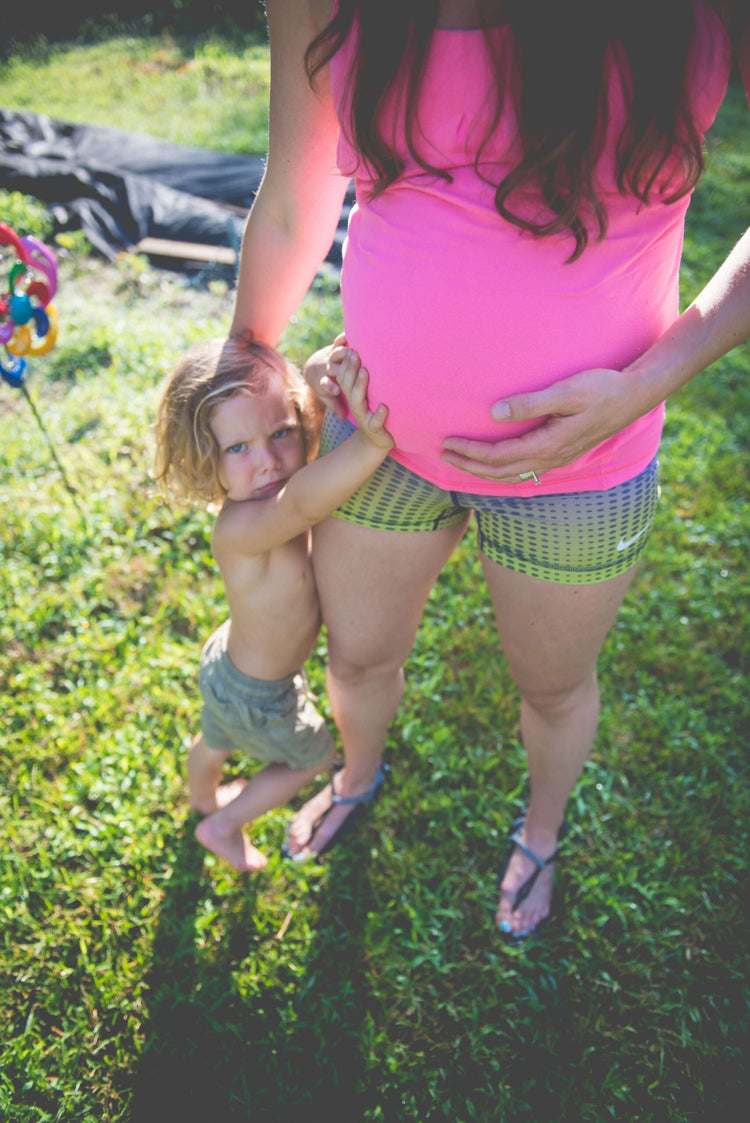
Why it Makes Sense to Switch Your Shoes During Pregnancy
From a big picture standpoint, pregnancy is a time of growth and change. The anatomy of a mother’s body is rapidly adapting to the projected growth of the fetus (things like a widening pelvis and ribcage, changes in spinal curvatures, stretching of abdominal tissues, and shifts in the center of gravity). A lot of the changes happening are credited to relaxin, a hormone that is found in numerous tissues and systems throughout the body, but increases during pregnancy and breastfeeding and acts to relax tissues. One of the changes that many women experience during pregnancy is a change in shoe size. Rather than lamenting this perceived inconvenience, I think it’s a perfect opportunity to take advantage of the body’s changing physiology. Feet that have been convinced to look like shoes rather than feet often have an uphill battle in regaining their natural shape, flexibility, and strength. But when relaxin is present, the body is more amenable to change. We can take advantage of this and invite our feet along for the ride. There are a few reasons why pregnancy is the best time to make the change to more neutral and natural footwear options. Here are three: As I mentioned earlier, there’s relaxin; this hormone is helping the body prepare for the baby to grow as well as exit the body, which means it’s making changes. Adding in some simple foot mobilization can feel great and also may help accelerate these changes. The shift forward in the center of gravity makes being pregnant similar to wearing high heels when non-pregnant. Doubling down on this shift forward causes most women to avoid wearing heels when pregnant. But whether they’re stilettos or traditional running shoes, shifting the center of gravity even further forward than it already is during pregnancy generally feels uncomfortable in the calves, quads, and low back. There’s no better time to be barefoot. Pregnancy calls us to really be IN our ever-changing bodies. Taking some time to pause, connect to the ground, and just BE can be incredibly beneficial. From a literal standpoint: the more comfortable you are with your feet on the ground, the easier it is to stay grounded. A few ideas to get started if you’re making footwear changes while pregnant: Go slow. There are a lot of changes taking place in your body; don’t overwhelm it. Start out just being barefoot in your house; once that’s completely comfortable, add in walking outside barefoot. When you change footwear, don’t wear your new shoes all day. Start with a few hours, and gradually build up the amount of time you spend in your new kicks. Speaking of new shoes: Your foot may continue to change sizes. As pregnancy progresses, your feet may increase in size; this might revert postpartum, but it might not. From an economical standpoint, it probably makes sense to get some multi-purpose shoes (ones you can wear to work, but also workout or go hiking in) rather than swapping out every single pair of shoes you own only to find that the size change was temporary! Wiggling your toes is a simple way to bring awareness to your feet and get them moving in a way that doesn’t typically happen while shod. Barefoot shoes allow for ample space for your toes. Try to move the toes individually and slowly for more of a challenge. Relaxin stays present in the body postpartum, so in the first few weeks postpartum while you are allowing your body to regulate to its new normal, you can gently work on foot and ankle mobilizations. A time of growth and change can be scary and overwhelming. But if we take small steps (literally), this amazing time can actually give us a much-needed boost in helping our body function at its best! Looking for shoes that will provide comfort during your pregnancy? The Prio Coast step-in hands-free sneaker is a great option. Lindsay Mumma, DC @lindsaymumma Photos by Amanda Ditzel, Raleigh Birth Photography The content of this post does not constitute and is not intended to be a substitute for professional medical advice, diagnosis or treatment. Always seek the advice of a physician or other qualified health provider with any questions or concerns you may have about your health or a medical condition.

Are you running WRONG?
What's the difference between "good running" and "bad running"?Those of us who promote natural movement and barefoot running have some thoughts about that.Typically, we talk about: Landing with your foot "under your body" (don't reach out in front of your body with your foot -- "overstriding") Increase your cadence a bit (there's no magic number, like 180 steps per minute, but increasing your foot speed without increasing your running speed makes overstriding more difficult) Land on your forefoot or midfoot (it's hard NOT to land that way if you don't overstride, and don't point your toes to make this happen. BTW, some research suggests forefoot is better because it lets you use the "spring" in your foot's arch) Keep your core engaged (you want to be a "tight spring") But what does SCIENCE say?Well, take a look at this super-cool presentation by David Mark, showing some running analysis by biomechanist Dr. Aaron Beachhttps://www.abc.net.au/news/2019-12-11/why-everything-you-thought-about-running-is-wrong/11775598They use some great visualizations to compare Olympian Jenny Blundell to recreational runner, Ruby Cornish.The only thing different in Beach's analysis and recommendations from what I show above, is that he doesn't suggest trying forefoot landings. But my bet is that if Jenny was a forefoot landing runner he'd comment on the value of doing so.One other subtle thing is that he recommends that Ruby have more hip extension (or what some would call "backside mechanics"). This isn't something to work on, but simply the effect of having a stride where your foot lands under -- or close to -- your center of mass, with the correct cadence.It why we say that good runners "run out of the back."I think you'll love the visualizations. Let me know what you think.
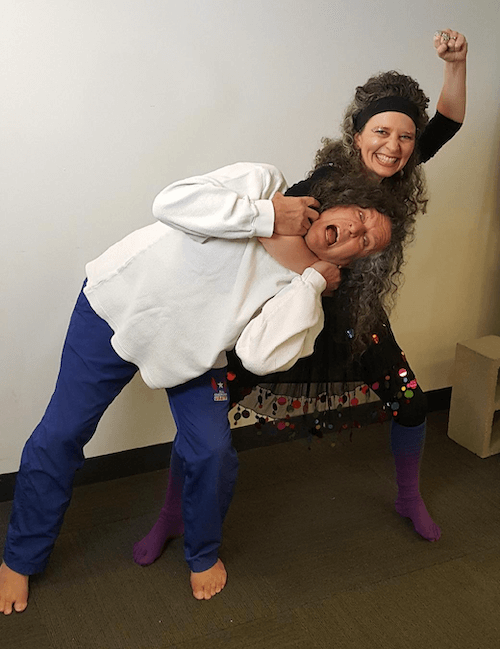
Happy Xero-ween!
Halloween is a favorite day here at the Xero Shoes office. Lena Phoenix -- Xero Shoes co-founder, CFO, and G.L.O.W. (Gorgeous Lady of Wrestling!) Halloween? Or just another typical Thursday at the Xero Shoes office? But, then again, we also dress up for "Onesie Wednesday" and "Non-casual Friday" (which is more open-ended than Formal Friday). Of course, some people go above and beyond and dress AS XERO SHOES! Whether you trick-or-treated or just gave out candy, if you did it Xero Shoes, we want to see your pics and how you Live Life Feet First!